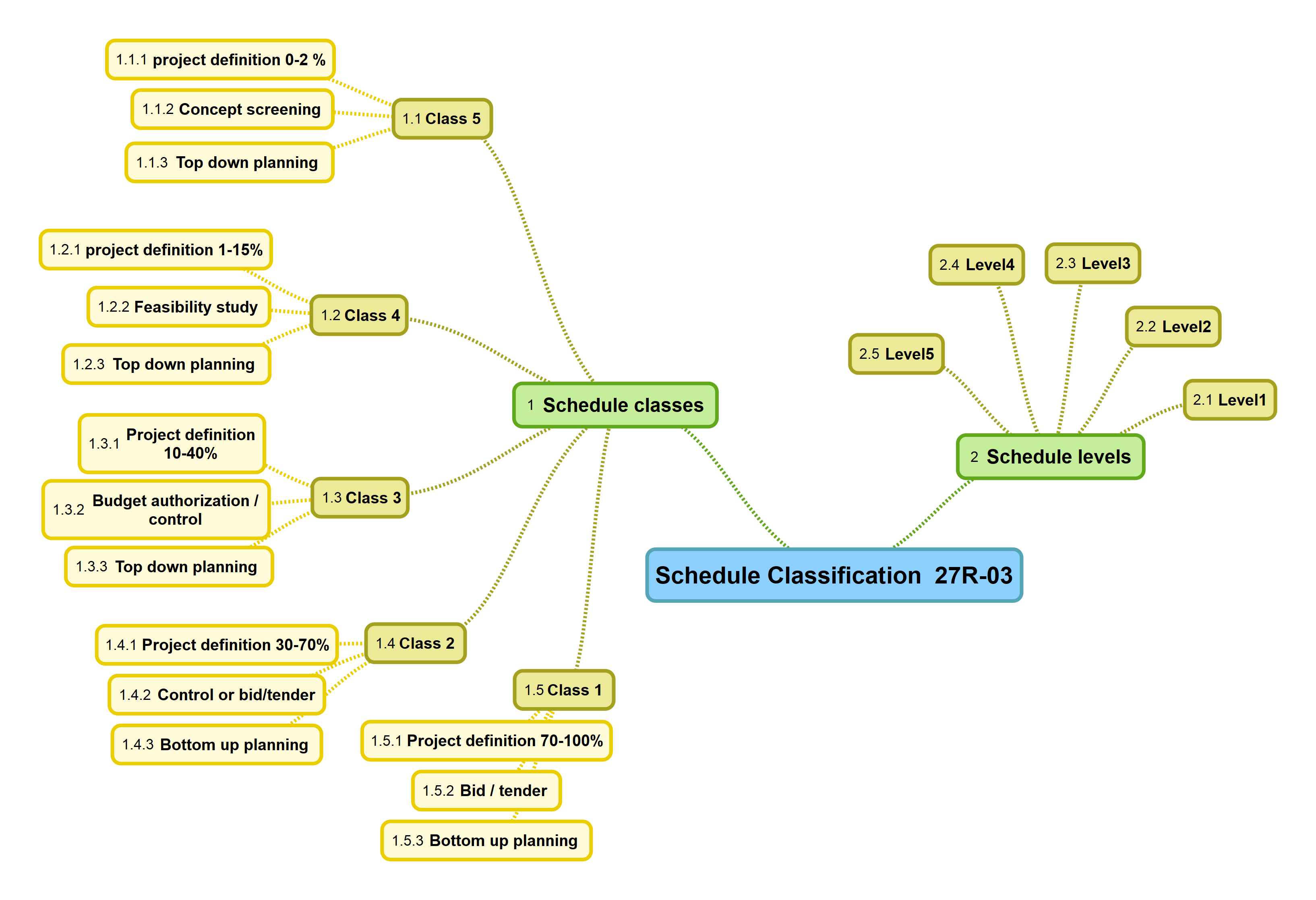
Schedules classified based on;
- Degree of project definition
- 1.1 Class5 – Prepared with limited information. Has the lowest level of project definition. Primarily used for concept screening. Developed using top-down planning and contains major milestones. Degree of project definition is 0% – 2%. Usually presented in either Gantt (bar chart) or table form.
- 1.2 Class4 – Prepared with limited information. Used for project screening, determination of “do-ability”, concept evaluation, and to support preliminary budget approval. schedule is primarily used for feasibility study. Semi detailed. Degree of project definition is 1% – 15%.C.
- 1.3 Class3 schedule is primarily used for budget authorization or control. Top down. Semi detailed. Degree of project definition is 10% – 40%.
- 1.4 Class2 schedule is used as a detailed control baseline against which all project work is monitored in terms of task starts and completions and progress control. Bottom up planning. Detailed in nature. Degree of project definition is 30% – 70%.C
- 1.5 Class1 schedule is the most accurate, fully expanded schedule. Used for bid / tender situations. Bottom up planning. Degree of project definition is 70% – 100%.
- End usage of the schedule
- Class5 -> Concept screening
- Class4-> Feasibility study
- Class3 -> Budget authorization / control
- Class2 -> Control and bid situations
- Class1 -> Bid / tender situations, tracking
- Scheduling approach used
- Top down planning
- Bottom up planning
- GANTT / bar charts
- Precedence diagramming method (PDM)
- PERT (Project Evaluation and Review Technique)
2. Schedule levels
Schedule levels establishes the level of detail required for communication, reporting (stakeholders), and execution. Higher the level indicates more granular information.
2.1 Level1
2.2 Level2
2.3 Level3
2.4 Level4
2.5 Level5

 Wrench Academy