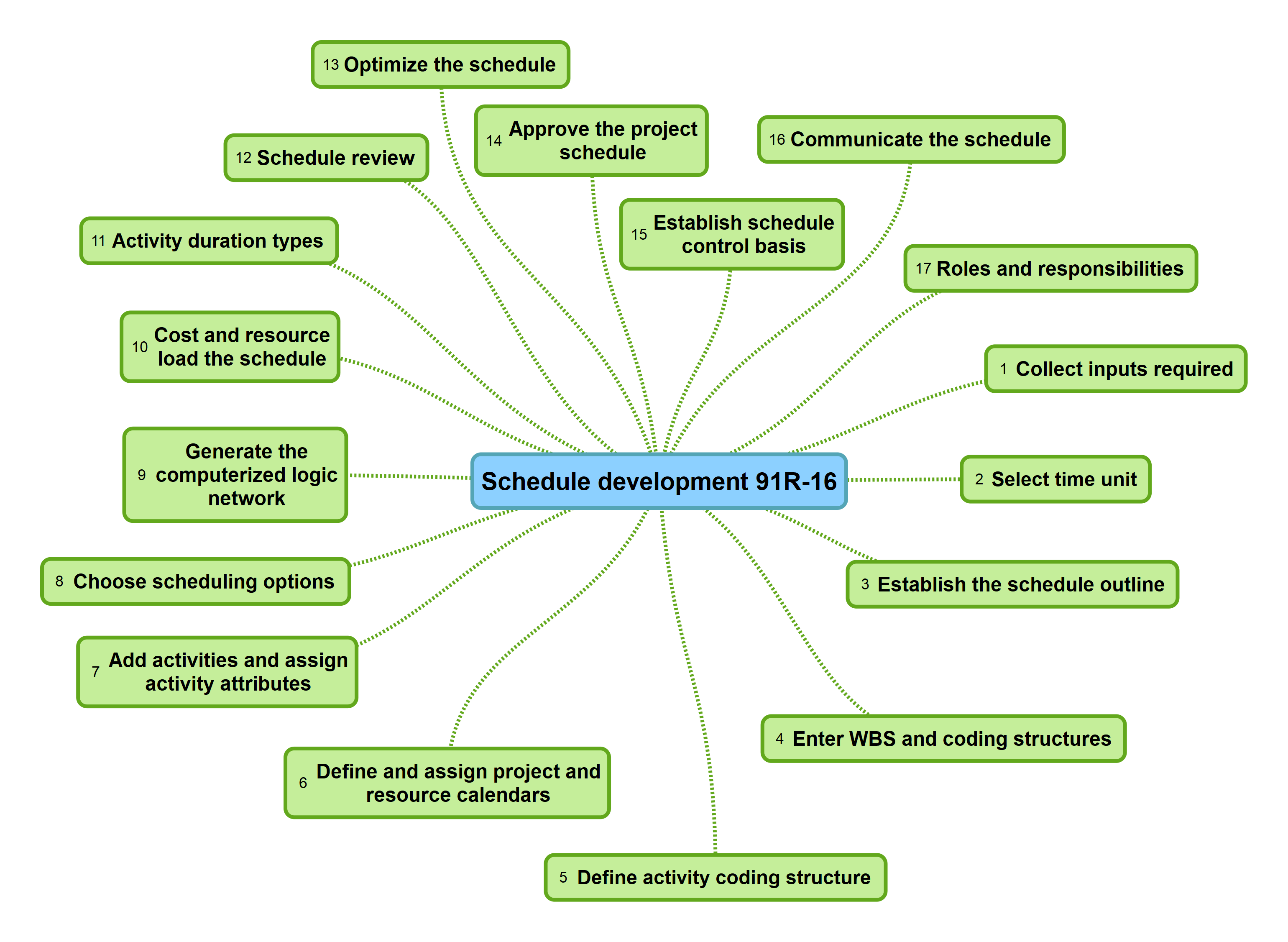
Steps involved
- Collect inputs required
- Scheduling requirements
- Plan for schedule development and monitoring
- Initial schedule model
- Historical records
- Technical documents
- WBS, Work packages and execution strategy
- Estimated costs
- Budgeted resources
- Resource planning
- Constructablity analysis
- Value analysis and engineering
- Risk analysis and management
- Procurement planning
- Schedule submittals
- Select time unit – Weeks, days or hours
- Establish the schedule outline / Schedule structure
- Enter WBS and coding structures
- Define activity coding structure
- Define and assign project and resource calendars
- Add activities and assign activity attributes
- Choose scheduling options – Configuration of the scheduling tool to incorporate end of day, beginning of the day settings
- Generate the computerized logic network
- Physical relationship (FS, FF, SS, SF)
- Safety relationship – When two activities happen in parallel, there can be safety hazards
- Resource relationship – Resource constraints have an impact on sequencing activities
- Preferential relationship – Discretion of the planning team
- Cost and resource load the schedule
- Activity duration types
- Fixed duration and units
- Fixed duration and units / time
- Fixed units / time
- Fixed units
- Schedule review
- Optimize the schedule
- What if scenario analysis
- Schedule risk analysis resulting in optimistic, pessimistic and most likely durations
- Decision tree analysis
- Montecarlo analysis
- Approve the project schedule
- Establish schedule control basis
- Communicate the schedule
- Roles and responsibilities

 Wrench Academy